Most conversations about AI and work begin with a blunt question: will it create jobs or remove them? The honest answer is that it will do both. But I think the question is too narrow to help leaders make good decisions.
A job is not one indivisible unit. It is a collection of tasks, decisions, relationships, and responsibilities. AI changes each part at a different speed. Routine execution may become much cheaper, while judgment, problem framing, review, and accountability become more important.
That changes the shape of work before it determines the final number of jobs. The organisations that understand this will redesign roles around what people can own with AI, not simply count how many tasks a model can perform.
The Jobs Debate Is Asking the Wrong Question
Looking only at job totals hides the more immediate change. AI rarely arrives and replaces an entire occupation in one clean step. It enters a workflow, takes on some tasks, changes others, and creates new review or coordination work around them.
The International Labour Organization's 2025 occupational exposure index found that one in four workers globally are in an occupation with some exposure to generative AI. Its more important conclusion is that transformation is the most likely effect because most occupations still contain tasks that require human input.
Exposure is not the same as elimination. A software engineer who delegates a first draft to an AI system still needs to understand the architecture, evaluate trade-offs, protect security boundaries, and accept responsibility for the result. A manager who uses AI to summarise customer feedback still needs to decide which signals matter and what the team should do next.
The better question is therefore: how does the mix of execution, judgment, and ownership change when AI becomes part of the team?
From a Job Pyramid to a Talent Diamond
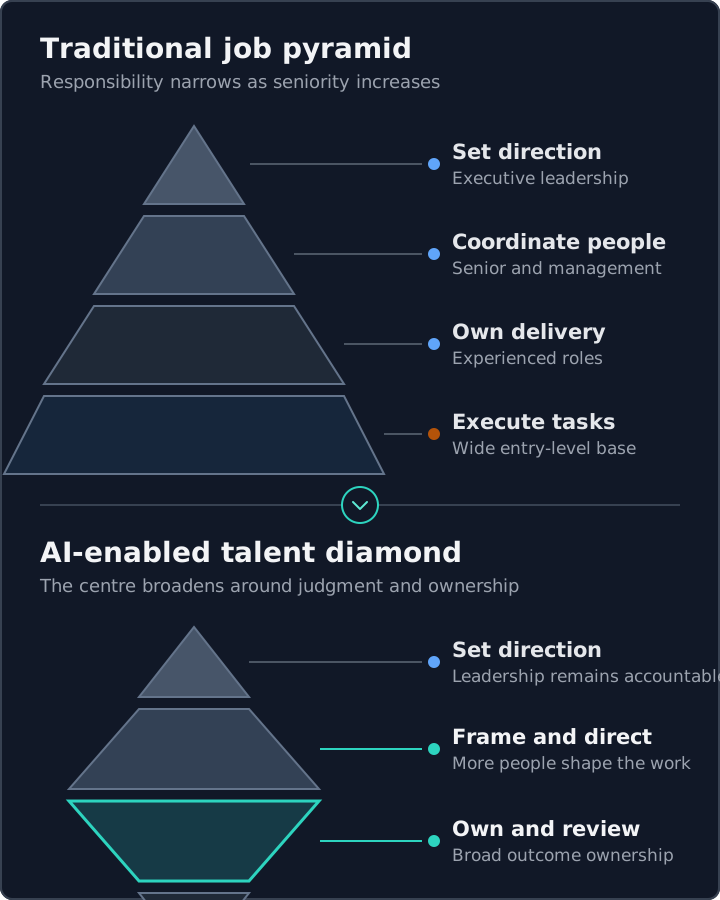
Traditional organisations are often pictured as a pyramid. A wide base performs repeatable work. A smaller group owns larger pieces of delivery. Senior people coordinate decisions and risk. A narrow leadership layer sets direction.
AI puts pressure on the widest part of that pyramid because repeatable, well-specified tasks are the easiest to automate or accelerate. But the work does not simply disappear upward. People closer to delivery can use AI to take responsibility for a broader outcome than they could before.
The resulting organisation may look more like a diamond: fewer roles built almost entirely around routine execution, a broader middle responsible for outcomes, and a leadership layer that remains accountable for direction and systems. This is a model, not a prediction that every company will follow. It describes the opportunity available to companies that redesign work deliberately.
AI Can Absorb Tasks, but Not Accountability
It is tempting to equate generating an output with owning the work. They are not the same thing. Producing code is different from deciding what should be built. Drafting an analysis is different from choosing the evidence that deserves attention. Suggesting an answer is different from being accountable when that answer affects a customer.
As the cost of producing a first draft falls, the value moves toward specifying the right problem, setting constraints, connecting context, checking quality, and deciding when the work is ready. These used to be responsibilities associated mainly with more experienced roles. AI makes it possible, and necessary, to distribute more of them through the organisation.
That is the real shift in seniority. It becomes less about how much material a person can produce alone and more about the quality of the outcomes they can direct and defend.
Why Greater Efficiency Can Create More Work
In The Coal Question, published in 1865, economist William Stanley Jevons argued that more efficient steam engines could increase total coal consumption. Better efficiency made steam power economical in more situations, which expanded its use. This became known as Jevons Paradox.
The same mechanism can apply to knowledge work. If AI lowers the cost of producing software, analysing information, or serving a customer, organisations may choose to do more of those things. Products that were previously too expensive become viable. Smaller customer segments become economical to serve. Teams can test more ideas before committing to one.
This is not a law that guarantees more jobs. Efficiency can also be used only to reduce cost. Demand may not grow enough to absorb the new capacity, and some roles will still shrink or disappear. The outcome depends on market demand and on what leaders choose to do with the capacity AI releases.
The World Economic Forum's Future of Jobs Report 2025 reflects that tension. It records employer expectations for both role creation and displacement, while placing skills change and reskilling at the centre of the transition. Those expectations are forecasts, not promises. What matters operationally is whether a company reinvests productivity into better products, broader service, and new demand.
The Promotion in Responsibility Is Not Automatic
Moving people from execution toward ownership sounds like a promotion, but it cannot happen by changing a job title. Someone who has only been asked to follow a process has not necessarily had the chance to practise setting goals, evaluating ambiguity, or making trade-offs.
This is why I am cautious about removing entry-level work without replacing the learning it provided. Routine tasks were often where people learned how systems behave, how customers describe problems, and how experienced colleagues make decisions. If AI takes those tasks, organisations need a new way to build the same context.
Apprenticeships, paired review, supervised AI work, rotations, and progressively larger areas of ownership become more important, not less. The talent pipeline will weaken if companies automate the first rung and assume experienced people will continue to appear.
The Skills That Become More Valuable
The skills that matter most are not limited to prompting. Prompting is useful, but it is one interface with a changing set of systems. Durable value comes from knowing what to ask, why it matters, and how to judge the answer.
- Critical thinking: separate a plausible answer from a supported one, identify assumptions, and recognise when the problem has been framed badly.
- Curiosity: explore alternatives, ask what has changed, and find opportunities that were not economical before.
- Adaptability: change methods as tools improve without abandoning sound engineering and business principles.
- Domain judgment: understand the customer, system, regulation, or market well enough to recognise a result that is technically polished but operationally wrong.
- Goal setting: translate an ambiguous need into a clear outcome, constraints, and measures of success.
- AI review: test outputs, trace evidence, check security and bias, and know when human escalation is required.
These skills reinforce one another. Curiosity without critical thinking creates noise. Domain knowledge without adaptability becomes stale. AI fluency without accountability produces output that nobody can safely own.
What Leaders Need to Redesign Now
Buying AI tools is easier than redesigning work. The difficult part is deciding where automation improves the system and where it removes the experience people need to grow.
I would start with four actions.
- Automate tasks, not job titles. Break roles into activities and assess each one for repeatability, risk, required context, and human accountability.
- Elevate ownership. Give people a wider outcome to own when AI removes part of the execution. Do not leave them supervising a tool without the authority to improve the surrounding process.
- Protect learning. Replace lost entry-level practice with structured review, apprenticeship, realistic simulations, and gradual responsibility.
- Measure value. Track customer outcomes, quality, cycle time, risk, and learning. Counting generated artefacts or hours saved says little about whether the organisation improved.
Job descriptions should follow the same logic. They need to describe the decisions a person will own, the systems they will direct, the standards they must uphold, and the skills they are expected to develop. A list of tasks frozen in time will become obsolete quickly.
FAQ: AI and the Changing Shape of Work
Will AI eliminate entry-level jobs?
It will reduce some roles built mainly around repeatable execution, and it will change many others. Complete elimination is not the only outcome. Entry-level roles can be redesigned around supervised AI use, customer context, review, and progressively larger areas of ownership. That redesign needs to be intentional.
What skills matter most in AI-enabled work?
Critical thinking, domain judgment, curiosity, adaptability, goal setting, and the ability to review AI output safely. Tool-specific skills matter, but they will change faster than the responsibility to frame good problems and own results.
Does Jevons Paradox prove that AI will create more jobs?
No. It explains how lower cost can increase demand enough to expand total use. Whether that produces more work depends on the market and on whether organisations reinvest capacity into new products, customers, and services. It is a useful possibility, not a guaranteed forecast.
How should leaders begin redesigning roles?
Start with tasks and decisions. Identify what AI can perform reliably, what still requires human context, who remains accountable, and how people will learn. Then redesign the role around a larger outcome rather than around a smaller list of manual tasks.
The Bottom Line
AI is not only changing how fast work gets done. It is changing where responsibility sits. Routine execution becomes cheaper, while framing, judgment, review, and ownership become more valuable.
That can produce better work and stronger careers, but only if leaders build for it. The goal should not be to preserve every old task or automate everything that moves. It should be to use AI to give people meaningful outcomes to own, then give them the skills and experience to own those outcomes well.